Piggable valves and ball valves
Wherever product flows into or out of the pigging line, you need valves that the pig can pass through. Our piggable ball valves have a smooth, full bore.
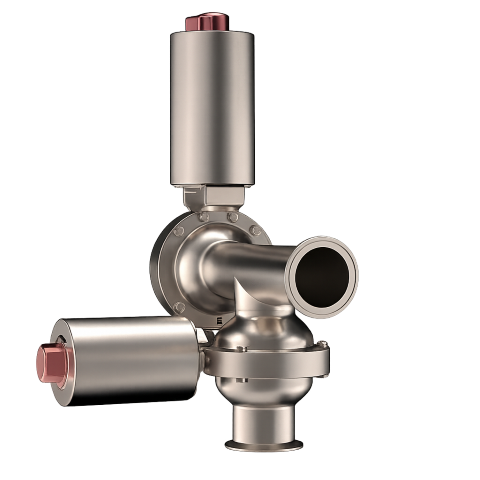
Product inlets and outlets that the pig can pass through
A standard valve or a tee without guide bars in a pigging line would damage the pig or leave product behind in a dead space. In the open position, piggable ball valves clear the full pipe cross-section so that the pig can pass through unhindered.
They serve as product inlets, as outlets to tanks or filling stations and for switching between line routes. All valves are made of stainless steel.
Applications
- Feeding product into the pigging line
- Outlets to tanks, filling stations and return lines
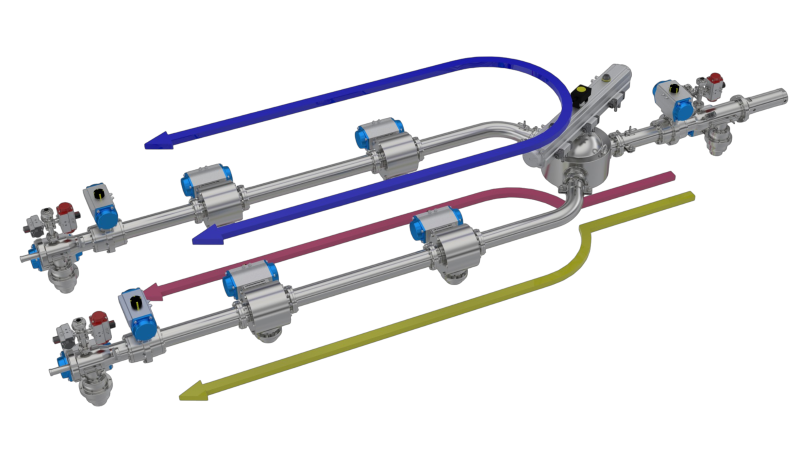
- Branches in pigging systems
- Integration into new and existing pigging systems
Valve variants
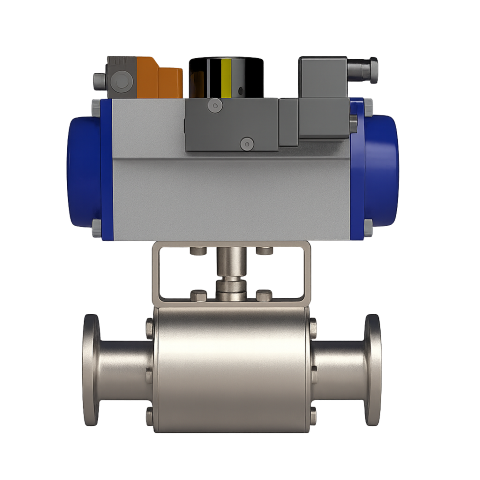
2-way ball valve
Opens and closes the product line. Free passage for the pig in the open position.
Enquire about a 2-way ball valve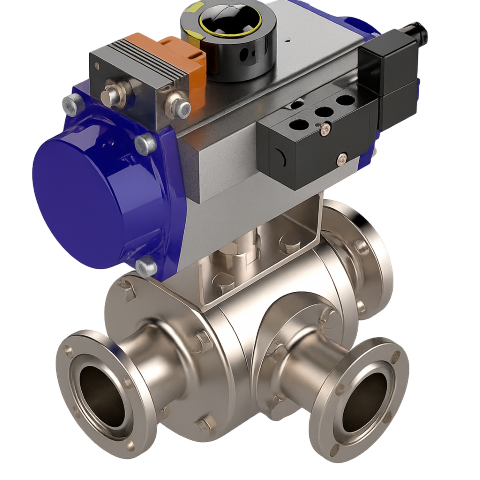
3-way ball valve
Switches the product flow between two line routes, for example at branches in the pigging system.
Enquire about a 3-way ball valveT-valve combination
Several ball valves in one unit as product inlet or outlet of a pigging line, in a space-saving design.
Enquire about a T-valve combinationProduct illustrations (rendering)
Technical data
Values that depend on the medium, temperature and mode of operation are defined for your plant. Suitability depends on the specific system and its operating conditions.
| Feature | Specification |
|---|---|
| Types | 2-way, 3-way, T-valve combination |
| Material | Stainless steel 1.4404 (316L) |
| Nominal sizes | DN 25 to DN 125other sizes on request |
| Actuation | manual, pneumatic or electric |
| Options | Trace heating, position feedback and sensors |
| Pressure, temperature, sealing materials | project-specificdesigned according to medium and operating conditions |
Other pigging valves
In addition to piggable ball valves, we supply valves that ensure process safety and control in the pigging system. Which of these make sense in your plant depends on the system layout.
- Non-return valves
- Double-seat valves
- Pigging valve blocks
What matters when selecting
- Function in the systemInlet, outlet, switching or a combination of these. This determines the type.
- Pipe system and connectionsInside diameter and connection type must match the pigging line so that the pig passes through without a step.
- Medium and temperatureThese determine the sealing materials and whether trace heating is required.
- Actuator and feedbackManual or automated; which position feedback signals the control system needs.
Matching components
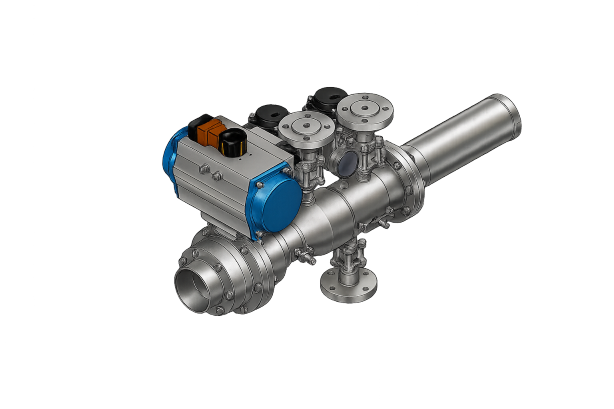 Pig launcherThis is where the pigging operation starts in the conveying direction. The launching station holds the pig, is closed pressure-tight and sends it into the line with the propellant.
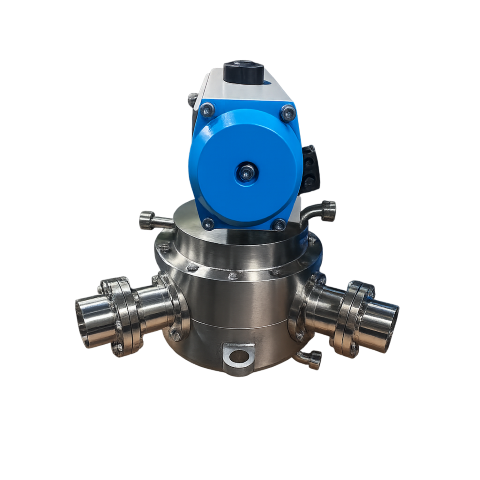 Pig divertersSwitching between pipeline routes
 Accessories and controlPipe components, propellant control, control heads
Frequently asked questions
Why can't standard valves be used in a pigging line?
Standard valves often have reduced cross-sections or dead spaces. The pig can get stuck on them or be damaged, and product remains behind. Piggable valves clear the full cross-section.
Can the valves be supplied with actuator and feedback?
Yes. The valves can be operated manually, pneumatically or electrically. We match control heads and position feedback to your control system.
Can the valves be installed in existing pigging systems?
Yes, provided the inside diameter and connections match the existing line. We check this using your pipeline data.
Discuss a project
Send us details of the medium and the pipeline, ideally with a sketch, or give us a call. We will get back to you with an initial technical assessment and tell you which details are still needed for the design.