Pigs for pipelines
We cast our pigs from silicone elastomer and design their shape and dimensions for your pipeline and your product.
Three designs for different tasks
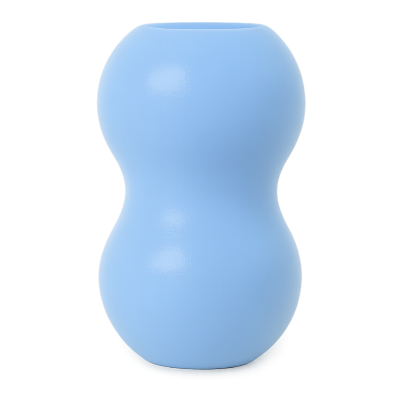
Spherical-segment pig
Compact pig made of cast silicone elastomer. Two spherical segments allow it to negotiate bends well and push the product out of the line.
Details and technical data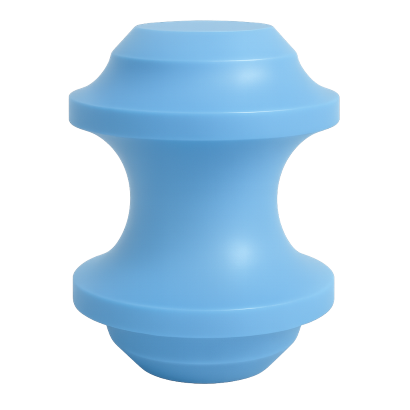
2-stage segmented pig
Two flexible sealing lips rest against the pipe wall and wipe off the product. A widely used design for product changeovers and recovery.
Details and technical data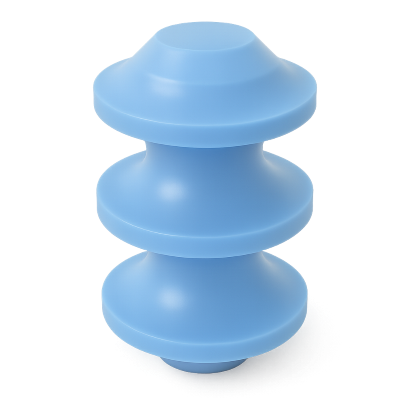
3-stage segmented pig
Three sealing lips form three wiping edges one behind the other. For applications in which as little product as possible should remain in the line.
Details and technical dataProduct illustrations (rendering)
The designs compared
Which design is suitable depends on the medium, the pipeline routing and the requirements for product displacement and separation. The table is for guidance only and does not replace a design.
| Feature | Spherical-segment pig | 2-stage segmented pig | 3-stage segmented pig |
|---|---|---|---|
| Design | Two spherical segments | Two sealing lips | Three sealing lips, two capture chambers |
| Strengths | Compact, negotiates bends well, for dual-pig systems | For product and batch changeovers | Additional scraper edge for adhesive products |
| Material | Silicone elastomer (VMQ) | Silicone elastomer (VMQ) | Silicone elastomer (VMQ) |
| Versions | OM · M · MK | OM · M · MK | OM · M · MK |
| Nominal pipe sizes | DN 25 to DN 100 | DN 25 to DN 100 | DN 25 to DN 100 |
With or without pig detection insert
So that the control system knows where the pig is, it can be fitted with a detection insert. Pig detectors on stations and valves then register it as it passes or in its end position.
Whether you need a detection insert depends on the degree of automation. In automated sequences it is usually a prerequisite for reliable step sequences.
| Code | Version |
|---|---|
| OM | without pig detection insert |
| M | with pig detection insert |
| MK | with pig detection insert encapsulated in stainless steel |
Design based on the inside diameter
A pig must seal tightly against the pipe wall without jamming. For the same nominal size, inside diameters differ depending on the pipe standard and wall thickness. That is why we ask for the pipe standard or the outside diameter and wall thickness.
More on this in the article The piggable pipeline.
For the design we need
- Pipe standard or outside diameter and wall thickness
- Pipeline routing with bends and fittings
- Medium with viscosity and special characteristics
- Product and cleaning temperatures
- Cleaning process
- Required detection (OM, M or MK)
Pigs to customer specification
Not every line fits a standard size. Because we design and cast our pigs ourselves, we also manufacture pigs to your specifications: for different inside diameters and pipe standards, as replacements for pigs from other manufacturers, or with a geometry matched to your product.
The basis is a drawing, an existing pig as a sample, or the data of your pipeline. We check in advance, on the basis of the pipeline, stations and valves, whether the requested version will run reliably in your plant.
How to get your pig
- Send us a drawing, sample or pipeline data
- We check dimensions, material and operating conditions
- You receive a quotation with version and delivery time
- We manufacture the pig and, on request, also supply it as a recurring wear part
- Dimensions
- Outside diameter, length and sealing lips matched to the actual inside diameter of your pipeline
- Shape
- Spherical segment, segmented pig with two or three sealing lips, or a modified geometry
- Material
- The standard is silicone; we check other elastomers for resistance to the product and cleaning
- Detection
- without pig detection insert, with pig detection insert, or with pig detection insert encapsulated in stainless steel
Frequently asked questions about pigs
What information does WE-HA need to design a pig?
The pipe standard or outside diameter and wall thickness, the pipeline routing with bends, the medium with temperature and viscosity, the cleaning process and whether the pig is to be detected. A sketch or a flow diagram helps with the assessment.
Does pigging replace cleaning of the line?
No. The pig pushes product out of the line and reduces product residues before cleaning. Whether and how the line then has to be cleaned depends on the product, the hygiene requirements and your cleaning concept.
Can replacement pigs be supplied?
Pigs are wearing parts. Since we manufacture them ourselves, we supply matching replacement pigs for plants with WE-HA components. For third-party plants, we clarify the dimensions on the basis of the line data.
Find the right pig for your pipeline.
Send us details of the medium and the pipeline, ideally with a sketch, or give us a call. We will get back to you with an initial technical assessment and tell you which details are still needed for the design.