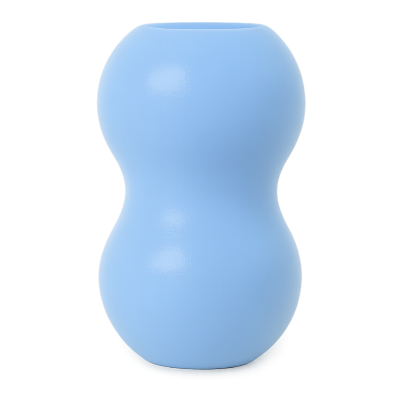
Spherical-segment pig
Compact pig made of cast silicone elastomer. Two spherical segments allow it to negotiate bends well and push the product out of the line.
- Design
- Two spherical segments, compact
- Material
- Silicone elastomer (VMQ), cast solid material
- Versions
- OM · M · MK
- Nominal pipe sizes
- DN 25 to DN 100
What does the spherical-segment pig do?
The spherical-segment pig displaces the line contents to the destination, i.e. into the tank, to the filling line or back into the process. This lets you recover product that would otherwise be lost during a product changeover or before cleaning.
Thanks to its compact shape, it also adapts well to lines with bends. It is suitable for systems in which two pigs are used one after the other.
Applications
- Product displacement and residual product recovery
- Emptying lines before a product changeover or cleaning
- Dual-pig systems
- Food, cosmetics, pharmaceuticals, chemicals, paints and coatings
Technical data
Values that depend on the medium, temperature and mode of operation are defined for your plant. Suitability depends on the specific system and its operating conditions.
| Feature | Specification |
|---|---|
| Design | Two spherical segments, compact |
| Material | Silicone elastomer (VMQ), cast solid materialStandard material silicone; other elastomers depending on resistance. Food contact compliance information on request |
| Versions | OM: without pig detection insert M: with pig detection insert MK: pig detection insert encapsulated in stainless steel |
| Nominal pipe sizes | DN 25 to DN 100Pig dimensions based on the inside diameter of the pipe system |
| Temperature, medium, cleaning | project-specificSuitability is determined for the medium, temperature and cleaning process of the plant |
What matters when selecting
We clarify these points with you before defining a design. A complete checklist is available in the article Information required for design.
- Pipe inside diameter and pipe systemThe pig is designed for the actual inside diameter, not for the nominal size alone. Pipe standard, wall thickness and tolerances determine the dimension.
- Pipeline routingThe number and radius of bends, internals, transitions and weld seams influence the pig shape and running behaviour.
- Medium and product propertiesViscosity, fat and solids content, particles and adhesion determine the lip geometry and wiping action.
- Temperature and cleaningProduct and cleaning temperatures as well as cleaning agents determine whether and how the pig remains in the line or is flushed around.
- DetectionWith a pig detection insert (version M or MK), detectors on stations and valves can register the pig position.
Documents on request
We compile documents on a project-specific basis. Let us know in your enquiry what you need.
- Dimensional data for your pipeline
- Information on material and food contact
- Installation and replacement instructions
Matching components
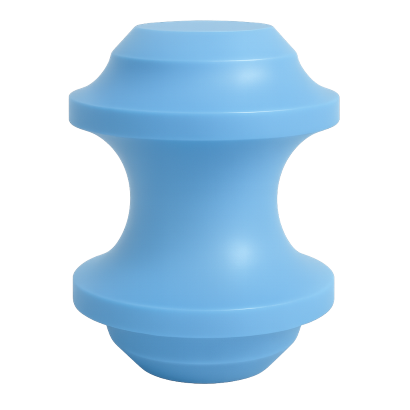 2-stage segmented pigTwo flexible sealing lips rest against the pipe wall and wipe off the product. A widely used design for product changeovers and recovery.
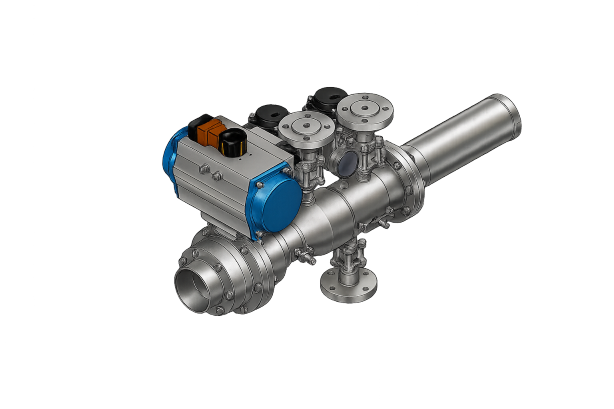 Pig launcherThis is where the pigging operation starts in the conveying direction. The launching station holds the pig, is closed pressure-tight and sends it into the line with the propellant.
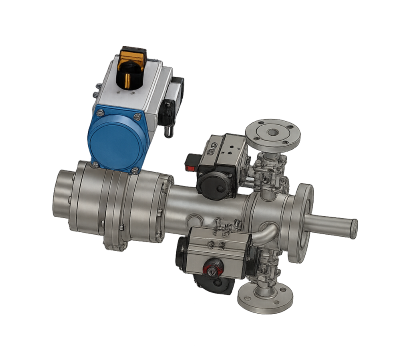 Pig receiverAt the end of the pigging line, the receiving station, also known as the catching station, takes up the pig, signals its arrival and allows depressurised removal.
Frequently asked questions about the spherical-segment pig
When is a spherical-segment pig the right choice?
When a compact design that passes bends easily is required, for example in lines with several bends or in systems with two pigs. Whether it is sufficient or a segmented pig with sealing lips is a better fit depends on the medium and the required wiping action.
What information does WE-HA need to design a pig?
The pipe standard or outside diameter and wall thickness, the pipeline routing with bends, the medium with temperature and viscosity, the cleaning process and whether the pig is to be detected. A sketch or a flow diagram helps with the assessment.
Does pigging replace cleaning of the line?
No. The pig pushes product out of the line and reduces product residues before cleaning. Whether and how the line then has to be cleaned depends on the product, the hygiene requirements and your cleaning concept.
Can replacement pigs be supplied?
Pigs are wearing parts. Since we manufacture them ourselves, we supply matching replacement pigs for plants with WE-HA components. For third-party plants, we clarify the dimensions on the basis of the line data.
Enquire about a spherical-segment pig for your plant
Tell us the medium, pipe data and mode of operation. The enquiry form already includes the product.